The $100 Question
GTA VI’s premium tier is not just a price increase. It is a live experiment in how far enthusiasm, status and FOMO can move the spending ceiling.
Table of Contents
› Quick Take› 89% Premium Share› $79.99 vs $99.99› The Two-Price Trick› Bottom LineThe real story is not that a $100 edition exists. It is that early buyers appear willing to choose it.
The 89% figure cited in the article is a third-party analyst estimate, not official Rockstar sales data. That distinction matters. But even as an early-buyer signal, the number is difficult to ignore.
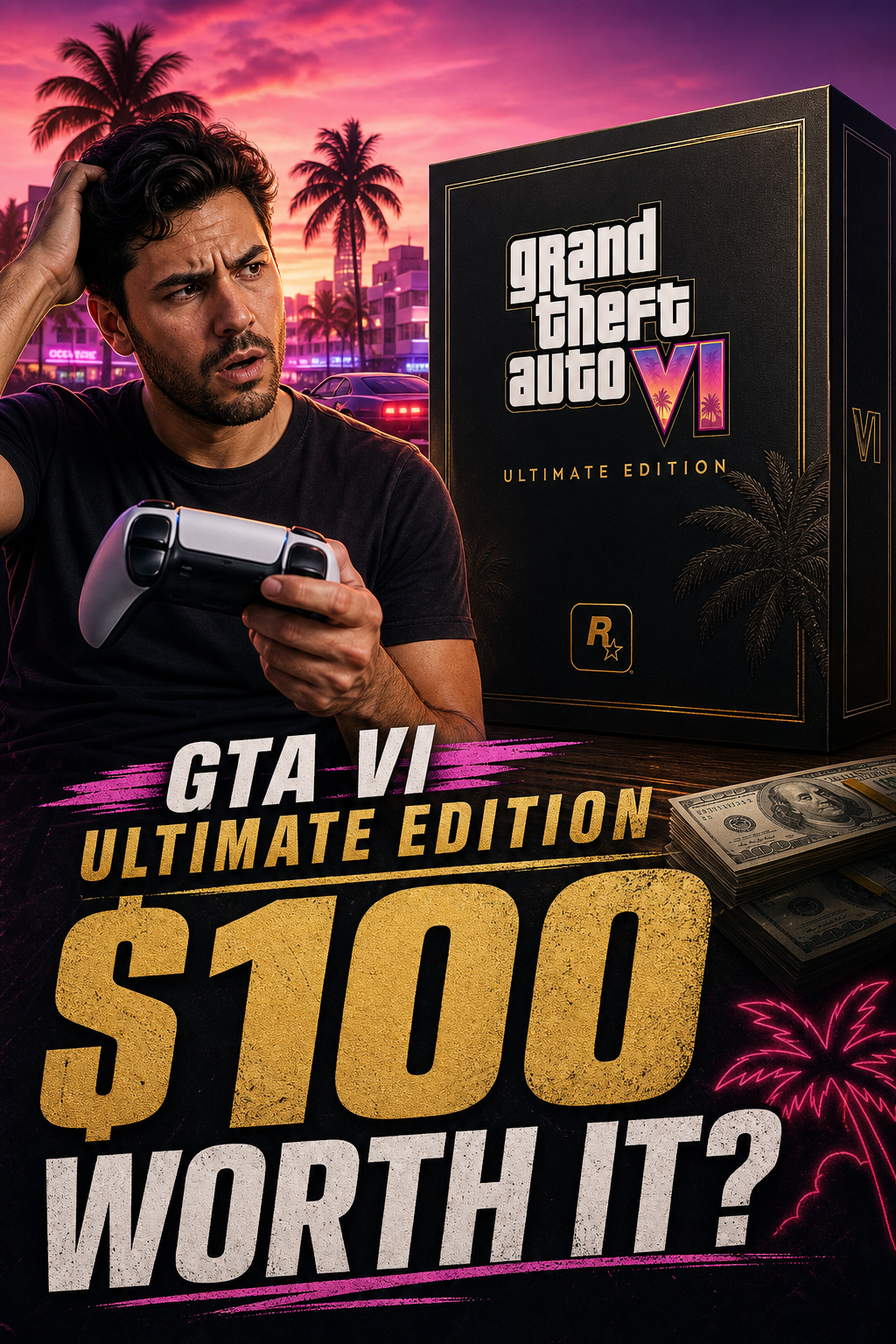
The anchor price.
The premium target.
Psychologically smaller than “a $100 game.”
The $100 Question: How GTA VI’s Ultimate Edition Rewrites the Price of Prestige
When Take-Two Interactive confirmed that Grand Theft Auto VI would launch with a $79.99 Standard Edition and a $99.99 Ultimate Edition, the internet did what it always does: it argued. Some called the price hike inevitable. Others called it greed. But buried in the fine print of a third-party analyst report is a number that should make every publisher sit up and take notice: roughly 89% of tracked preorders are for the Ultimate Edition.
That figure, from Sensor Tower and reported by TechRadar, is not official Rockstar sales data. It’s an estimate, and it comes with caveats. But if it’s even close to accurate, it suggests something far more interesting than “Gamers will pay more.” It suggests that Rockstar has cracked a psychological pricing puzzle that the rest of the industry has been fumbling for years.
The Two-Price Trick
Here’s the conventional wisdom: if you want to charge $100 for a game, you slap a $100 price tag on it and brace for backlash. Rockstar didn’t do that. They set the Standard Edition at $79.99—already a $10 jump from the traditional $69.99—and then positioned the Ultimate Edition as a $20 premium over that. The advertised entry price is still $79.99, which is high but not historically outrageous. The $99.99 tier is framed as an upgrade, not a base price.
That framing matters. Behavioral economists call it anchoring. The $79.99 price becomes the reference point, and the $99.99 tier suddenly looks like a modest leap rather than a psychological barrier. You’re not buying a $100 game; you’re buying a $79.99 game with a $20 boost. The difference is subtle, but it’s the difference between a luxury purchase and a splurge.
Why 89% Might Be Real (and Why It Might Not)
Let’s be clear: the 89% figure is a Sensor Tower estimate, not a Rockstar or Take-Two disclosure. It’s based on tracked preorder data, which skews toward the most engaged, most committed fans. The people who preorder a game months in advance are the same people who buy collector’s editions and season passes. They are not the average player who waits for a sale or picks up the game at launch after reading reviews.
So the 89% number likely overstates the Ultimate Edition’s share of the total audience. As the release date approaches and mainstream buyers start preordering, that percentage will probably drop. But even if it falls to 50% or 40%, it would still be an extraordinary premium share. For context, industry analysts have noted that premium editions typically account for a fraction of sales, often in the 10-20% range. A 40% share would be double or triple the norm.
What makes this even more striking is that the Ultimate Edition doesn’t include a season pass or future DLC. It includes premium vehicles, weapons, apparel, and “additional content.” That’s a vague promise, and yet players are flocking to it. Why?
The Psychology of the Premium Tier
Rockstar has always understood status. GTA Online is built on it—the cars, the clothes, the properties. The Ultimate Edition is a status symbol before you even load the game. It says, “I’m not just playing GTA VI; I’m playing it in style.”
But there’s a deeper force at work: the fear of missing out, or FOMO. When a game is as culturally dominant as GTA VI, players worry that they’ll be left behind if they don’t have the premium content. Will the exclusive vehicles be overpowered? Will the apparel be a badge of honor in online lobbies? Rockstar hasn’t said, but the ambiguity is part of the appeal. The unknown is more tantalizing than a detailed list of items.
There’s also a practical angle. GTA Online is a persistent world, and players know that Rockstar will likely introduce content that makes the premium items desirable. The $20 difference is a hedge against future regret. It’s insurance against the possibility that the Ultimate Edition becomes the “real” GTA VI experience.
What This Means for the Industry
If the 89% estimate holds—or even if it settles at a lower but still high number—it could reshape how publishers price their biggest games. The lesson isn’t “charge more.” It’s “make the premium tier feel essential.”
For years, publishers have experimented with $99.99 “Gold Editions” that bundle the base game with a season pass. Those often sell poorly because they feel like a bundle, not an upgrade. Rockstar’s approach is different: the Ultimate Edition is a distinct product with its own identity. It’s not just the game plus extras; it’s the game, elevated.
This could also ease the pressure to raise base prices. If publishers can get a large share of players to voluntarily pay $100, they don’t need to risk the backlash of a $100 base price. The $79.99 Standard Edition becomes a decoy—a price that makes the Ultimate Edition look reasonable. It’s a classic pricing tactic, but Rockstar may have executed it better than anyone before.
The Open Questions
We’re still in the early days. The 89% figure is a snapshot of the most enthusiastic fans. As the marketing machine ramps up and the game gets closer to launch, we’ll see whether the mainstream audience follows suit. If the Ultimate Edition share drops to 30% or 20%, the story changes. If it stays above 50%, Rockstar will have proven that premium pricing can be the default, not the exception.
There’s also the question of what’s actually in the Ultimate Edition. Rockstar has been characteristically vague. If the “additional content” turns out to be cosmetic-only, some players may feel burned. If it includes gameplay advantages, others will cry pay-to-win. Either way, the backlash could be fierce.
The Bottom Line
GTA VI is more than a game; it’s a cultural event. And Rockstar has turned that event into a pricing experiment. The 89% estimate, if accurate, suggests that players are willing to pay a premium not just for content, but for the feeling of being part of the inner circle. That’s a powerful insight for any publisher.
But it’s also a warning. The same psychology that drives players to the Ultimate Edition can turn against a company if the premium tier feels exploitative. Rockstar is walking a tightrope. So far, they’re making it look easy. The real test comes when the game launches and players discover what they actually bought.
For now, the $100 question isn’t whether players will pay it. It’s whether the industry will learn the right lesson—or the wrong one.
If you are already thinking premium, compare premium controllers too.
The same value question applies to hardware: paying more only makes sense when the upgrade changes the experience enough to justify the premium.
Browse Premium Gaming Controllers on eBayAffiliate link. GearCheckpoint may earn a commission from qualifying purchases.
GearCheckpoint Verdict
If the premium share remains unusually high as mainstream buyers arrive, GTA VI may teach the industry that the easiest path to a $100 game is not raising the base price to $100. It is making the premium tier feel like the obvious choice.
Leave a Reply