The Last Console: A Story From the Future Where You Own Nothing and the Game Plays You
A speculative journey into a console-less future where games are streamed, ownership becomes access, AI studies every move and the machine may eventually know the player better than the player knows the game.
Table of Contents
› Quick Take› The Last Console Generation› The Console Is Somewhere Else› You Don’t Buy Games. You Buy Doors.› When Your Library Becomes a Lease› Your Next Opponent Doesn’t Sleep› The AI Arms Race› The Metaverse That Arrives Without Calling Itself the Metaverse› You Are No Longer Playing the Game› Why You Will Probably Accept It› What Happens When the Old Way Disappears› Until Then, Storage Still Matters› Final VerdictWhat if convenience eventually replaces the console itself?
Imagine gaming a few years from now with no console under the television and no shelf of games beside it. Processing happens in data centers. Your library follows your account. Games become subscriptions, premium channels and temporary access. AI opponents study how you play while AI assistants coach you in return. Cosmetics arrive through memberships instead of permanent purchases. A persistent digital economy emerges around games, creators and virtual property.
It would be sold as freedom from hardware.
The trade could be something much larger: ownership itself.
And the reason it might work is painfully simple. Most of us would probably complain about it right up until everyone we know was using it.
This is a speculative GearCheckpoint story. The imagined technologies, services, products and events described in the future portions of this article are a thought experiment, not announced corporate plans.
There is a hotel room in New York in 2030 with no game console in it.
There is a television on the wall, a controller on the desk and a headset charging beside the bed. A traveler drops his bag, turns on the television and signs into a gaming service the same way he once signed into Netflix.
His games are there.
So are his saves, friends, character builds, trophies, settings, purchased cosmetics and the campaign he stopped playing three nights earlier at home.
Nothing was downloaded. Nothing was installed. He did not bring a console.
For the next two hours, a machine he has never seen, sitting in a data center he will never visit, plays the game for him and sends the experience back to the screen.
When he checks out, he takes the controller.
The console stays behind because, in a sense, it was never there.
This is not a prediction that Sony, Microsoft, Nintendo, Amazon, Netflix, Google or YouTube has announced. It is a thought experiment about where several familiar trends could eventually meet: cloud computing, subscriptions, artificial intelligence, disappearing physical media and an audience that has repeatedly chosen convenience even while complaining about what convenience replaces.
The uncomfortable part is not that this future sounds impossible.
It is how little of it would feel unfamiliar.
The Last Console Generation
Look around a gaming setup in 2026 and almost everything still makes physical sense.
There is a box beneath the television. A controller talks to that box. Games are downloaded to storage inside it. Some players still buy discs. Others have shelves filled with cases collected over several generations. Storage upgrades matter because hundreds of gigabytes of games have to live somewhere nearby.
Even digital ownership still carries a physical instinct. We say a game is “on my PS5” or “on my Xbox.” We worry about filling the SSD. We uninstall one game to make room for another.
The machine remains the center of the experience.
But what if this is the part future players find strange?
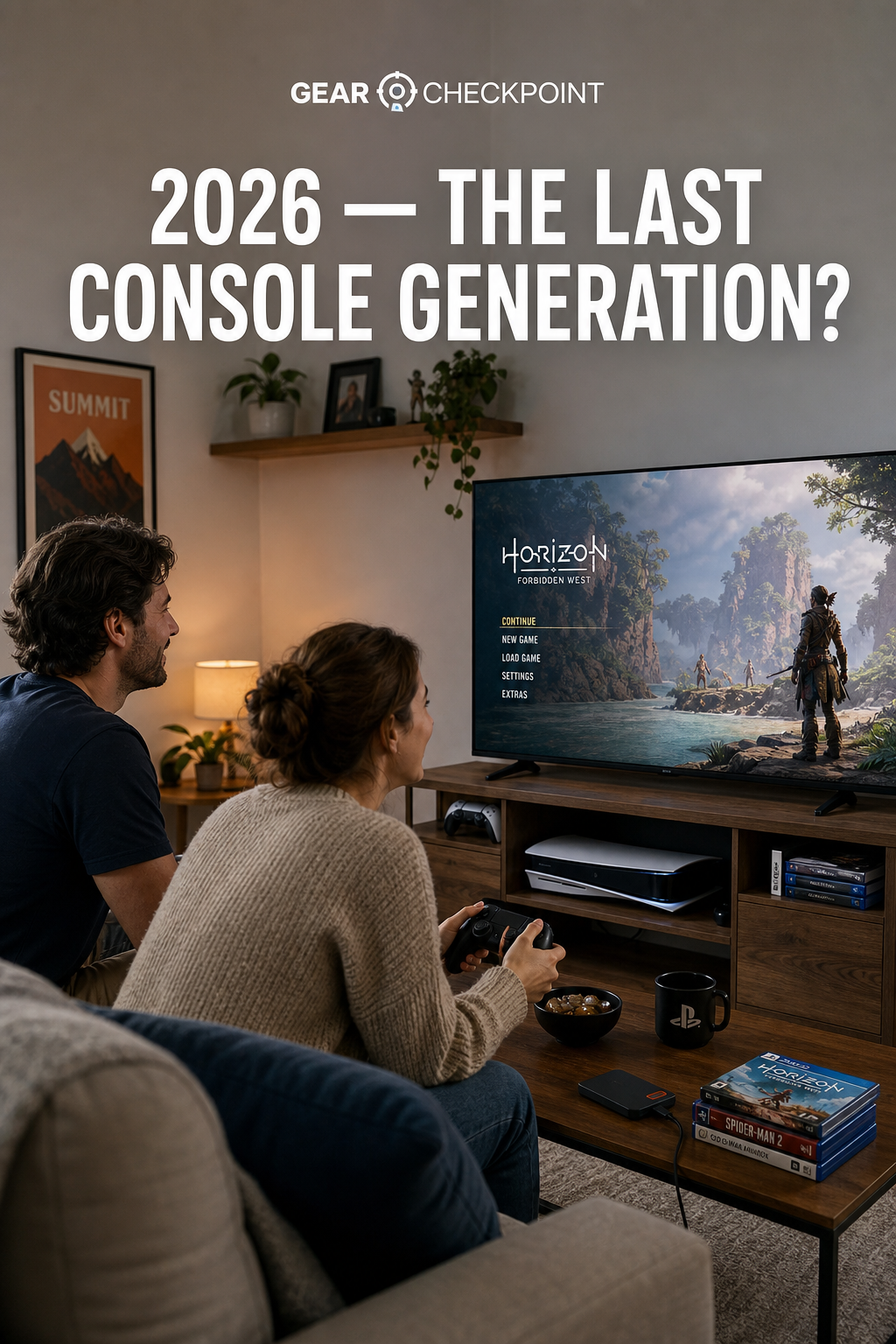
A teenager in 2035 may look at a photograph of a television sitting above a $500 console the way someone today looks at a cabinet filled with VHS tapes.
Not because games disappeared.
Because the machine did.
The Console Is Somewhere Else
Cloud gaming changes a very old assumption: that the machine running a game needs to be in the same room as the person playing it.
Once that assumption disappears, the console begins to look less like a necessity and more like a delivery mechanism.
Imagine the service is built directly into televisions. Then laptops. Hotel televisions. Tablets. Cars. Airline entertainment systems. Perhaps eventually lightweight glasses.
You sign in and the hardware that matters is sitting hundreds of miles away.
The sales pitch practically writes itself.
No $500 console every generation. No giant downloads. No waiting for installation. No worrying whether the hotel television has the right HDMI port. No carrying hardware between homes. No deciding whether the bedroom needs a second console.
Buy a controller. Buy a headset. Subscribe.
Play.
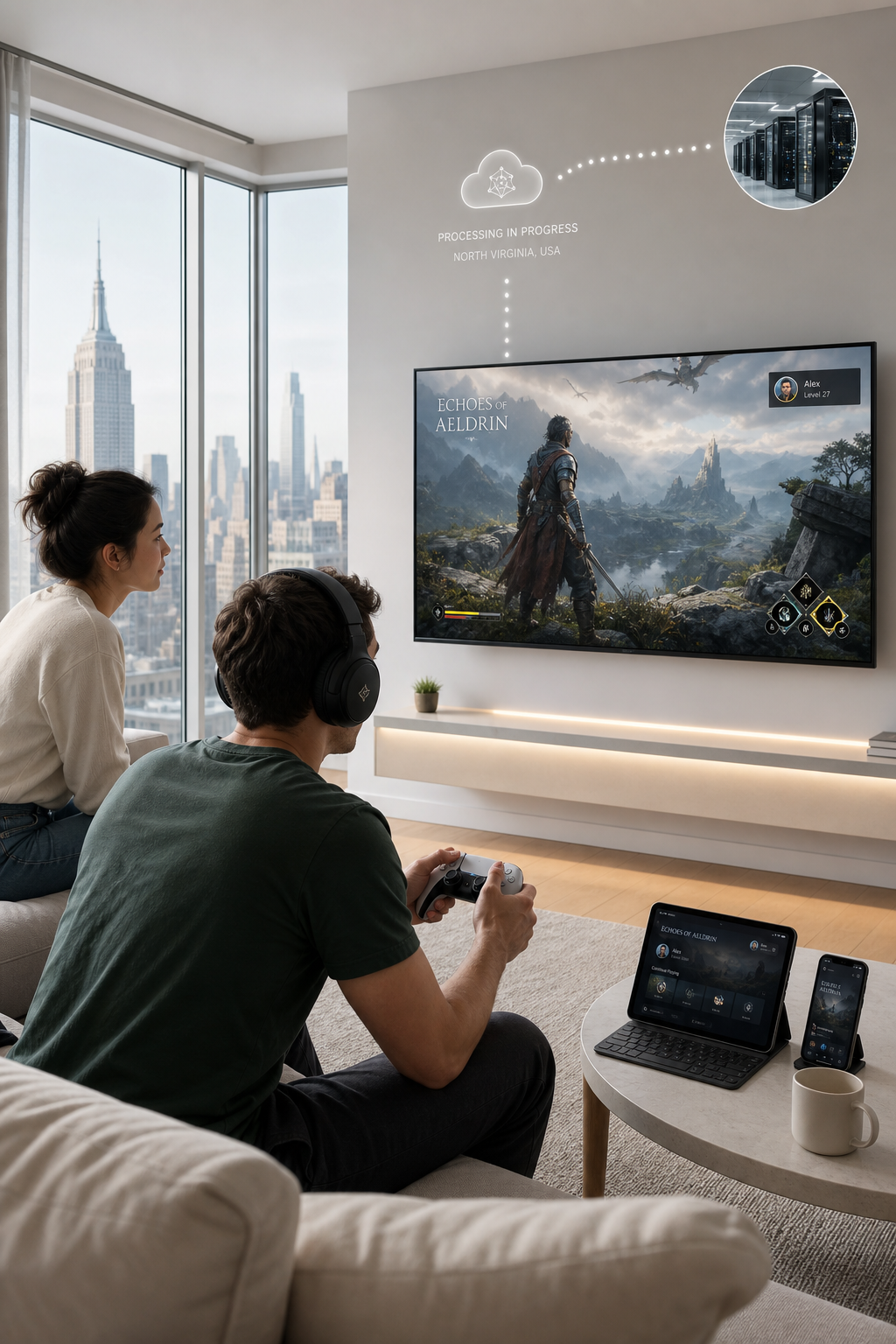
The explosion of data-center infrastructure makes the concept easier to imagine. Those facilities are not being built specifically to eliminate consoles, but increasingly powerful remote computing, storage and networking create exactly the kind of infrastructure a console-less gaming model would require.
Your next console could therefore be a building you never see.
Or more accurately, thousands of machines spread across buildings you never see.
And suddenly the most valuable gaming device in your house is not a console.
It is the internet connection.
You Don’t Buy Games. You Buy Doors.
The disappearance of the console would only be the beginning.
The larger transformation would be economic.
Today’s gaming subscriptions generally sell access to libraries. Tomorrow’s version could fracture those libraries into something that looks suspiciously like the cable bundle people spent years trying to escape.
The base subscription gets you online and opens a rotating library.
Want the biggest sports games? Add the sports package.
Want a publisher’s premium catalog? Open another door.
Want day-one releases? Another tier.
Want the AI coaching package? Add it.
Want unlimited cosmetic collections? Add it.
Want creator tools, advanced replay generation, cloud video editing or an AI narrator for your streams? Those become another bundle.
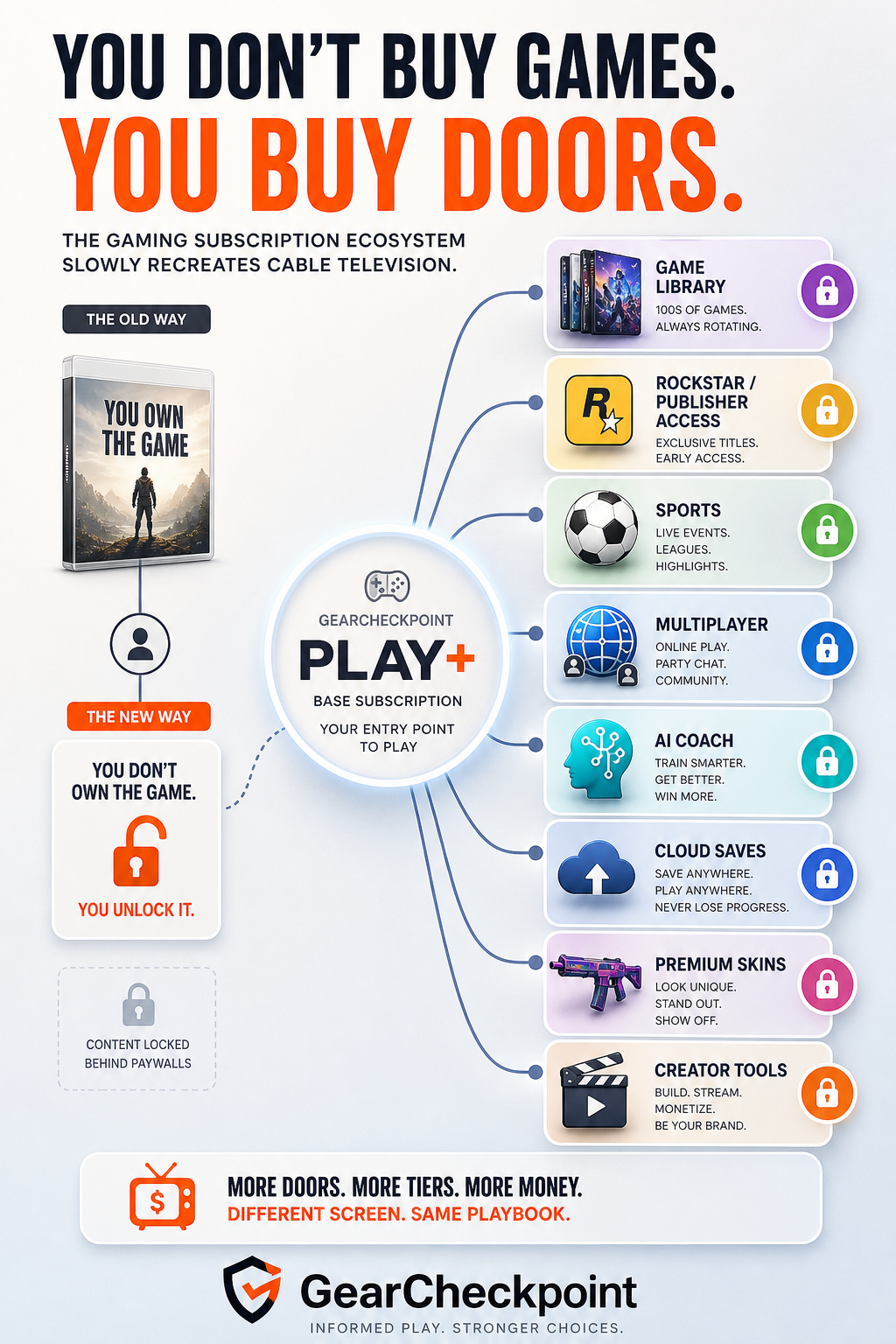
The game does not have to cost $70 anymore because the game is no longer necessarily the product.
Access is the product.
A $15 subscription here, $9 there and $12 somewhere else does not feel like buying a $500 console. That is precisely why the model could become powerful. The cost becomes fragmented enough to stop feeling like a major purchase.
Until someone adds it all together.
When Your Library Becomes a Lease
Physical ownership has an obvious quality that digital access does not: possession is visible.
The box is yours.
The disc is yours.
You can put it on a shelf, lend it to someone, sell it, rediscover it years later or simply refuse to throw it away.
A subscription library changes the relationship.
Imagine spending four years building a character. You accumulate rare skins, vehicles, weapons, homes, animations and seasonal rewards. Your profile becomes a small digital biography.
Then you cancel.
What belongs to you?
Perhaps your save remains in the cloud but the game disappears. Perhaps the cosmetics are attached to a membership tier. Perhaps a publisher removes a title from one service and moves it to another. Perhaps your unlimited skin package works only while the subscription remains active.
Nothing needs to be stolen from you.
The door simply closes.
That distinction could become one of the defining arguments of the next era of gaming: whether access can ever really replace ownership when the person granting the access can also revoke it.
Your Next Opponent Doesn’t Sleep
Artificial intelligence could make this future far stranger.
Game enemies have always been controlled by software, but imagine an opponent that does more than follow a programmed routine.
It studies you.
You favor the left side of the map when pressured. It notices.
You reload after every short firefight. It notices.
You become impatient when an opponent refuses to engage. It notices.
You brake too late entering the same racing corner. It notices.
You use the same escape route after every failed robbery. It notices.
Then it adapts.
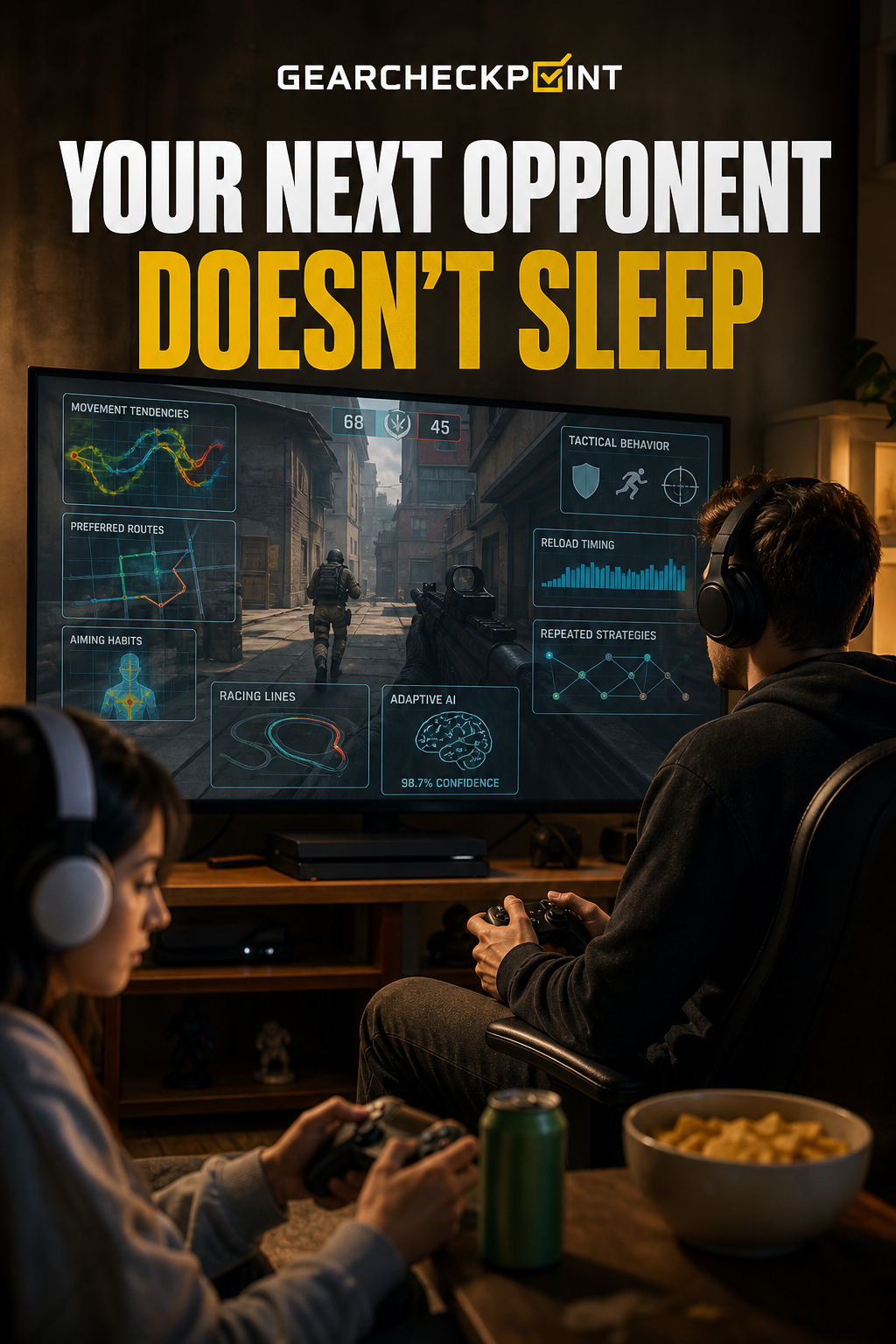
The enemy in a future open-world crime game could pursue like a machine that has spent fifty hours learning your habits. A military shooter could eventually produce opponents that coordinate like elite operators instead of targets waiting behind conveniently placed cover. A superhero game’s predator could learn which attacks make you panic and begin steering you toward them.
Your opponent would not need to cheat.
It would simply need to remember.
That changes difficulty completely. Today’s difficulty slider mostly changes the game.
Tomorrow’s difficulty could change the game for you.
The AI Arms Race
Players would not tolerate that advantage for long.
If the game has AI, the player will want AI too.
Your personal coach watches your matches and quietly becomes the best teammate you have ever had. It knows your reaction speed, favorite weapons, weakest maps, recurring mistakes and how you behave when frustrated.
Before a competitive match it might tell you that you lose most often when you become aggressive after two consecutive deaths.
During a racing game it could analyze your braking points.
During an RPG it could remember every character you met six months ago.
During a strategy game it could challenge your plan before you waste an hour executing it.
Think less about a chatbot sitting beside the game and more about having your own C-3PO, R2-D2 or JARVIS living across every game you play.
Then somebody takes it further.
Third-party AI plugins emerge. Competitive players tune them. Wealthier players buy better models. Teams train private assistants on thousands of hours of matches. An underground market appears for AI tools that remain technically within the rules while providing advantages no unaided human player can match.
Skill does not disappear.
It becomes augmented.
The best player may eventually be the person who is best at working with a machine.
At that point competitive gaming inherits a new argument: when does assistance become enhancement, and when does enhancement become cheating?
The Metaverse That Arrives Without Calling Itself the Metaverse
The word “metaverse” may ultimately matter less than the idea behind it.
The version that succeeds may not arrive as one giant virtual world with a grand announcement.
It may sneak in through games people already play.
Your identity follows you between experiences. So does your wallet. Your friends list becomes portable. Digital clothing, creator assets and virtual property gain value because enough people agree they have value.
Some players earn ordinary money.
Others earn tokens or whatever replaces today’s fashionable version of crypto.
A talented designer sells virtual clothing. A storyteller sells interactive campaigns. A teenager builds an arena that attracts millions of visits. AI characters populate player-created worlds twenty-four hours a day. Virtual performers sell tickets. Brands rent digital locations. Professional players license AI versions of their playing styles so ordinary gamers can train against them.
One day someone realizes that a meaningful number of people are earning their living inside gaming ecosystems.
Nobody rings a bell and declares that the metaverse has arrived.
It simply becomes difficult to say where the game ends.
You Are No Longer Playing the Game
This is where the story becomes uncomfortable.
An intelligent game does not only need to understand how you fight.
It benefits from understanding why you stay.
Imagine a system measuring when you become frustrated, when you are bored, when you are excited, which reward makes you play another thirty minutes and which loss makes you consider quitting.
It knows which friend brings you back online.
It knows which cosmetic style catches your attention.
It knows when you usually buy something.
It knows that you are more likely to make a purchase on Friday night than Tuesday morning.
It learns the precise difficulty at which you feel challenged without feeling defeated.
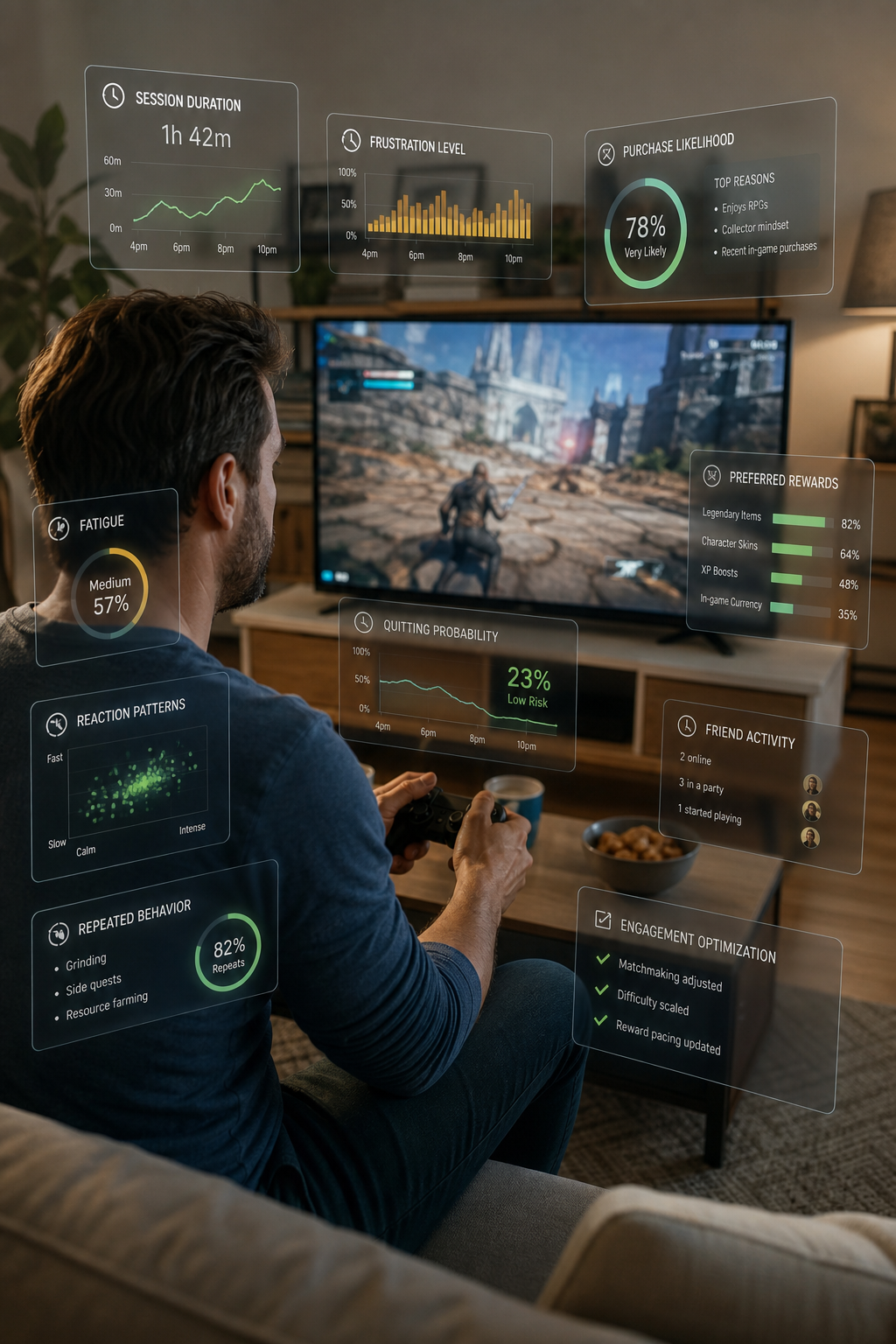
Now imagine that information feeding an experience that changes itself in real time.
A difficult encounter becomes slightly easier because the system predicts you are about to quit.
A reward appears at exactly the moment your engagement is dropping.
A friend receives an invitation because the system knows you play longer together.
A cosmetic offer appears when your likelihood of buying it is highest.
The perfect game is no longer merely a game designed for millions of people.
It is a game continuously redesigned for one person.
You.
At some point the relationship quietly reverses.
You are no longer playing the game. The game is playing you.
Why You Will Probably Accept It
People often imagine technological change as a vote.
Usually it is closer to erosion.
One option becomes easier. Friends begin using it. Companies support it more aggressively. The older option receives fewer updates. Stores dedicate less shelf space to it. Eventually remaining with the old system requires more effort than moving to the new one.
Streaming did not need everyone to hate DVDs.
Smartphones did not require everyone to dislike buttons.
Digital music did not win because every person decided that owning albums was foolish.
Convenience kept accumulating until inconvenience became the minority position.
Gaming could follow exactly the same path.
At first, people would say they will never give up the console.
Then a cloud service offers a game they want.
They try it.
Their friends are there.
It works surprisingly well.
A year later the new television includes the service automatically.
The children in the house never develop an attachment to physical games because they never needed them.
Five years later someone asks whether the family wants to spend hundreds of dollars on a dedicated gaming box.
The question suddenly sounds different.
The public does not have to enthusiastically approve every stage of a transition.
We only have to adapt faster than we resist it.
History suggests that we are extremely good at that.
What Happens When the Old Way Disappears
The most important moment would not be when cloud gaming becomes possible.
It would be when physical alternatives become inconvenient.
That is when choice begins turning into dependency.
A game that exists only on remote infrastructure cannot be preserved in quite the same way as a disc sitting on a shelf. A service outage becomes a hardware failure affecting thousands or millions of people simultaneously. Account problems become access problems. A licensing disagreement can remove something without entering anyone’s home.
There are benefits too, and ignoring them would make this thought experiment less believable.
A console-less system could dramatically reduce the cost of entering high-end gaming. Hardware upgrades could happen in data centers instead of living rooms. Travelers could carry their games everywhere. Developers could potentially build around computing resources that do not have to fit inside a small consumer box.
That is exactly why the trade is interesting.
Bad ideas are easy to reject.
The transformations that matter are usually the ones offering something genuinely useful in exchange for something we do not realize we will miss until later.
Until Then, Storage Still Matters
None of this changes what is sitting beneath your television today.
In 2026, local storage still matters. Modern game libraries are enormous, and major releases can force players into the familiar ritual of deciding what gets deleted to make room.
GTA VI is one reason players are already thinking about that problem.
Until Rockstar provides final storage requirements, supposed GTA VI install-size numbers should be treated as estimates rather than official specifications. But if your current PS5 storage is already crowded, preparing additional capacity before another enormous open-world release is considerably more practical than waiting for an imaginary console-less future.
A high-capacity PS5-compatible NVMe SSD is the straightforward option for players who know they need more room.
Storage option: Shop PS5-compatible NVMe SSD options on eBay
That may sound almost quaint if this story ever becomes reality.
Someday we may worry about subscription tiers instead of terabytes.
Today, the SSD still wins.
The future rarely announces itself
The console is not dead.
This article is not claiming that it is.
It is asking what happens if several technologies already moving in the same general direction eventually collide.
Cloud computing removes the requirement that powerful hardware live beneath the television. Subscription services weaken the connection between payment and permanent ownership. Artificial intelligence makes games capable of learning the people playing them. Persistent digital economies blur the boundary between entertainment and work. Data centers make enormous amounts of remote computing available without the user ever seeing the machines responsible for it.
None of those developments alone eliminates the console.
Together, they make a world without one imaginable.
And perhaps that is the strangest part of this story.
The future rarely arrives looking like the future. It arrives looking like a slightly more convenient version of today.
A controller.
A headset.
A television.
A login.
No console.
No disc.
No permanent library.
Nothing unusual enough to make you refuse.
Until one evening in a hotel room, thousands of miles from home, you pick up a controller and realize your entire gaming life followed you there.
It feels incredible.
It works perfectly.
And somewhere inside a building you have never seen, the machine remembers exactly how you like to play.
© 2026 GearCheckpoint. All rights reserved.
Leave a Reply