Wolverine vs. The Modern Man
When Real Life Doesn’t Give You a Health Bar
Table of Contents
› Quick Take › The Enemies Don’t Have Faces › What Happens to the Pressure? › Why Gaming Works Differently › The Modern Man Is Changing › What If He Doesn’t Come Back? › What Happens When the Fake World Feels Better Than the Real One? › Wolverine Doesn’t Need You to Be Polite › But There Is a Line › Escapism Has Always Been Here › The Enemy Has a Health Bar › Final VerdictThe world keeps telling men to control their anger. Wolverine is about to hand them a controller.
When Marvel’s Wolverine arrives on PlayStation 5 on September 15, 2026, Logan will enter a world built around a fantasy that is almost embarrassingly simple: the thing making you angry has a face.
It can be found.
It can be fought.
And, eventually, it can be beaten.
The average man opening his inbox on a Tuesday morning does not enjoy that luxury.
His opponent may be an HR email using the word “restructuring.” It may be a rent increase, another grocery bill that somehow costs more than the last one, a mortgage rate that turned homeownership into a spreadsheet exercise, a relationship that quietly disappeared, a custody schedule, a dating app that feels more like unpaid administrative work, or an algorithmic job market capable of rejecting him before another human being ever sees his name.
He cannot growl at his manager, and he probably shouldn’t put three claws through the electric bill.
Wolverine can fight the person hurting him.
Modern pressures often have no face.
That leaves a question more interesting than whether Insomniac’s Wolverine game will be violent, cinematic or fun.
What happens to male frustration when there is nowhere obvious for it to go?
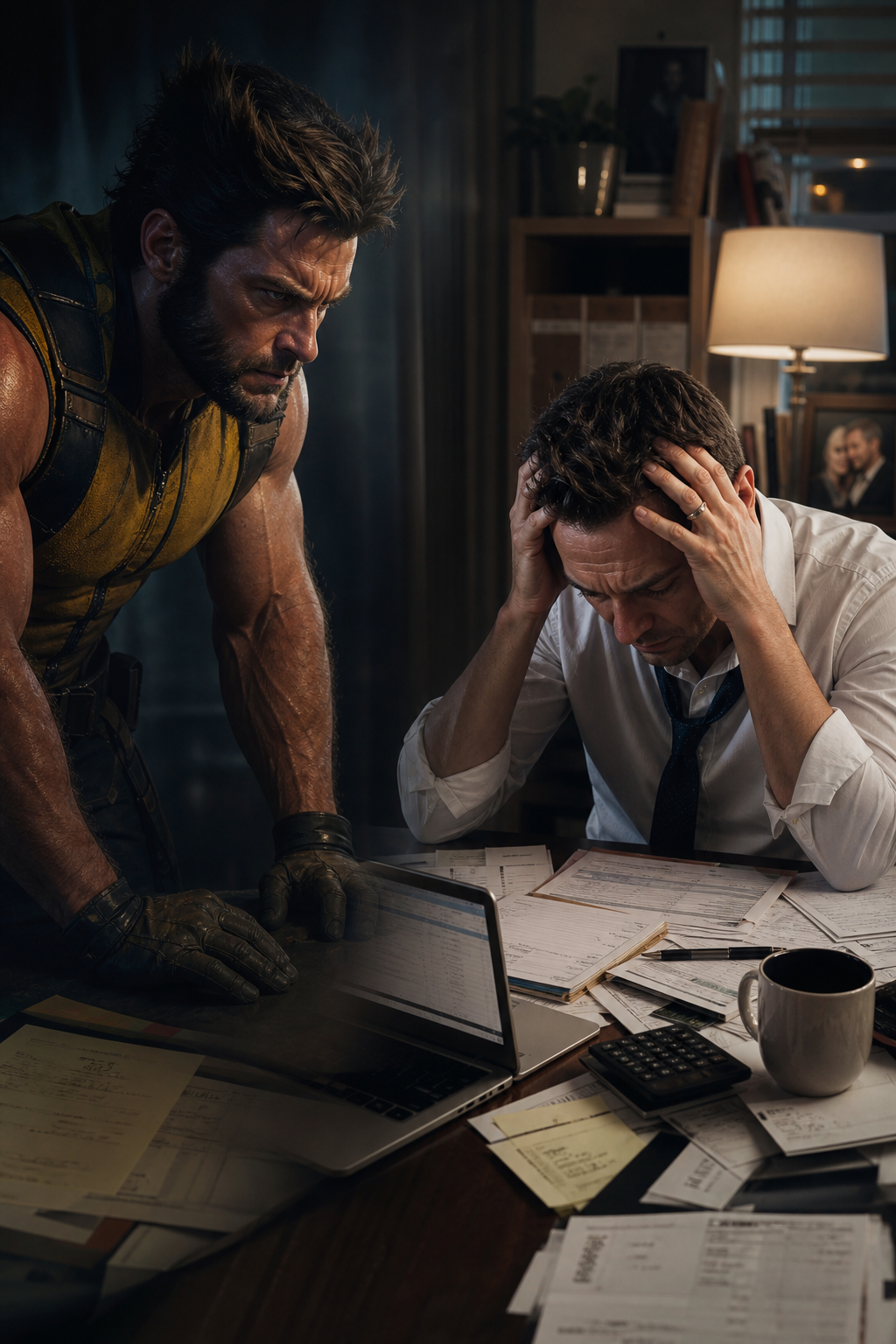
When the enemy has no face
Wolverine lives in a world where anger has an obvious target. Modern men often do not.
A layoff, housing costs, loneliness, dating fatigue, family paperwork or economic pressure cannot be punched, defeated or watched through a shrinking health bar. Society reasonably expects men to regulate themselves, remain productive and behave like adults, but the friction does not disappear simply because acting on it would be stupid.
For some men, gaming can provide something temporarily useful: a defined problem, visible progress and a place to decompress. Fitness, travel, friendship, hobbies and meaningful work can serve similar purposes.
That does not make PlayStation therapy.
It makes games one of several arenas where effort can still produce an understandable result.
The more interesting question is what happens when those alternate arenas become more satisfying than the traditional milestones men were once told would define adulthood.
The Enemies Don’t Have Faces
Wolverine is a fantasy of direct consequence.
Something hurts him. He finds it. He hurts it back. The math is brutal, but at least the equation is visible.
Compare that with the actual inbox of a thirty-four-year-old man in 2026.
The layoff email says “restructuring.”
His rent goes up again.
A relationship that seemed promising ends through silence.
The custody schedule his lawyer describes as standard rearranges another month of his life.
The job application disappears into an automated system.
None of it has claws.
None of it heals overnight.
Most importantly, none of it has a face he is allowed to hit.
Modern men operate inside systems that often produce pressure without producing an obvious antagonist. Housing costs move. Companies reorganize. Algorithms sort applicants. Relationships fail. Paperwork arrives. Markets change.
A man cannot punch his mortgage rate.
He cannot fight inflation in a parking lot.
He cannot suplex an algorithmic job market.
Civilization depends on that distinction. Emotional regulation is not oppression; it is part of being an adult.
But restraint does not erase frustration. It only determines what a responsible person does with it.
What Happens to the Pressure?
Sometimes it goes to the gym.
Sometimes it goes into a pair of running shoes at six in the morning.
Sometimes it goes into work, travel, motorcycles, a garage project, church, friends, music or an absurdly expensive hobby that requires three YouTube tutorials just to get started.
And sometimes it goes into a video game.
That does not mean games cure the problems outside the screen. A controller cannot negotiate rent, rebuild a marriage, restore a lost job or make loneliness disappear.
But decompression does not have to solve a problem to be useful.
Research on gaming and stress has found that limited game sessions can, in some settings, reduce measures of stress. That is a modest claim, and it should remain one. Playing Wolverine after a miserable workday is not psychotherapy.
Sometimes recreation is simply recreation.
That has always mattered more than people like to admit.
Why Gaming Works Differently
A good game creates something the real world increasingly refuses to guarantee: a visible relationship between action and result.
Complete the mission.
Earn the upgrade.
Learn the attack pattern.
Lose.
Try again.
Improve.
The game may be difficult, but difficulty is usually legible.
Real life frequently is not.
A man can do everything his company asked and still be included in a layoff.
He can save diligently and watch housing move farther away.
He can spend an evening carefully writing dating-app messages that never receive an answer.
He can follow the rules and still lose.
Games are different because they are deliberately constructed environments. Designers spend years making cause and effect feel satisfying.
That sense of agency matters.
Not because the achievement is equivalent to raising a child, building a career, maintaining a friendship or caring for a family.
It is not.
But for a few hours, the rules are visible.
That alone can feel luxurious.
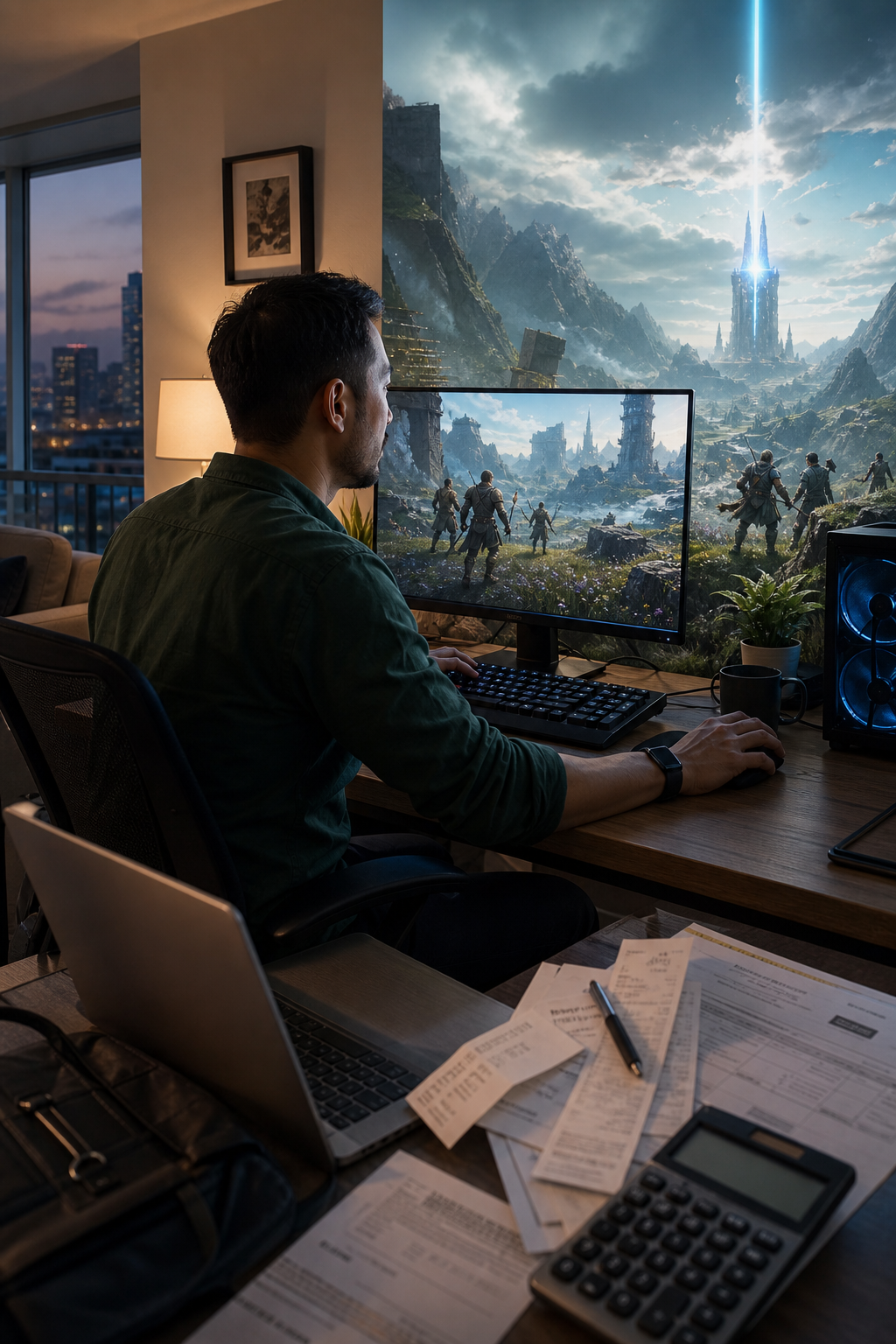
The Modern Man Is Changing
The cultural picture around men has changed enough that pretending otherwise is becoming difficult.
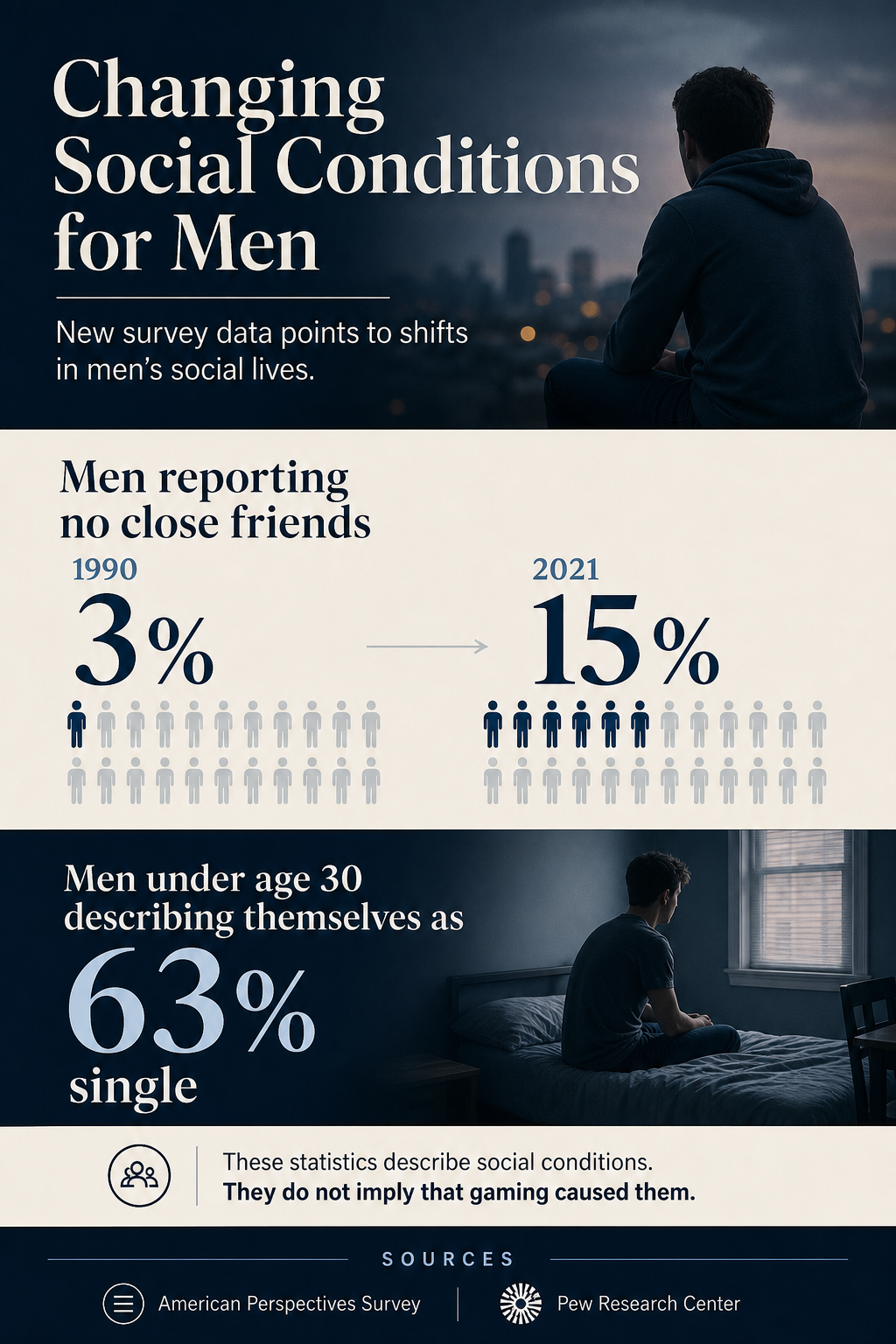
In the 2021 American Perspectives Survey, 15 percent of men reported having no close friends. In 1990, that figure was 3 percent. Over the same period, the share of men reporting six or more close friends fell sharply.
Pew Research Center has also reported that 63 percent of men under 30 described themselves as single in its survey data.
Those numbers do not prove that men are abandoning relationships.
They certainly do not prove that video games caused anything.
They do, however, describe a generation of men moving through a social environment that looks different from the one many of their fathers and grandfathers knew.
At the same time, the menu of possible lives has expanded.
A man may still want marriage, children, a house and the familiar progression toward retirement.
Another may want Tokyo.
Madrid.
Remote work.
A gaming room he spent four years building.
A group of friends he met through a hobby.
Cars.
Investing.
Fitness.
Travel.
A Discord server containing people he has known longer than some of his neighbors.
For decades, adulthood was described as though everybody were supposed to arrive at roughly the same checkpoints.
Get established.
Get married.
Buy a house.
Have children.
Provide.
Retire.
Millions of men will still choose that life and find enormous meaning in it.
The change is that it is no longer the only imaginable route.
What If He Doesn’t Come Back?
This is where the conversation becomes uncomfortable.
What happens when a man discovers that the places where he feels most competent, respected or alive are not the places society told him would matter most?
Maybe he travels instead of buying the house.
Maybe he values a tight group of friends more than another promotion.
Maybe the expensive gaming setup in the spare room means more to him than upgrading the kitchen.
Maybe he stops treating marriage as an inevitable milestone and begins treating it as one possible life choice.
That does not automatically mean he is failing to grow up.
It also does not automatically mean he has discovered some superior philosophy.
People build meaningful lives in different ways.
The interesting part is that technology gives them more places in which to build those lives.
And games are becoming particularly good at offering the things human beings once had to seek almost entirely offline.

What Happens When the Fake World Feels Better Than the Real One?
Games offer friendship.
Competition.
Status.
Exploration.
Achievement.
Community.
Purpose.
Control.
Increasingly, they offer memory too.
AI-driven characters can remember player behavior. Opponents can adapt. Stories can react more deeply to choices. Virtual companions can maintain continuity across encounters.
The game begins to understand the player.
That is exciting.
It is also worth thinking about.
Real life has a remarkable ability to make a man feel replaceable.
Employee number 84721 gets eliminated during restructuring.
His access disappears.
His email stops working.
The organization continues.
A video game can make him the protagonist.
The village needs him.
The mission cannot begin without him.
The squad is waiting.
The story literally stops when he puts down the controller.
That is an extraordinarily powerful contrast.
If virtual worlds continue getting better at providing recognition, progress, companionship and agency while the real world becomes more bureaucratic and impersonal, the competition for human attention will become increasingly uneven.
The fake world does not have to become more important than reality.
It only has to become easier to feel important inside it.
Wolverine Doesn’t Need You to Be Polite
That is one reason Wolverine remains such a perfect character for this moment.
Logan is damaged.
He is angry.
He is difficult.
He carries history around like scar tissue.
Yet the world he inhabits has somewhere to put all of that.
His rage becomes useful.
Nobody asks Wolverine to compose a carefully worded email, circle back Monday or wait while his concerns are forwarded to the appropriate department.
His problems tend to arrive with body armor.
The fantasy is not merely violence.
It is clarity.
Wolverine knows what the threat is.
He knows where it is.
And the game gives him the means to respond.
For a little while, he gets claws.
But There Is a Line
An outlet can become a bunker.
There is a difference between using a game to decompress and building a life in which the game is the only place you experience accomplishment, friendship, challenge or control.
The gym still matters.
Friends still matter.
Travel can matter.
Meaningful work matters.
Relationships matter.
Family and children can matter profoundly for men who want them.
The purpose of recreation is not to make reality unnecessary.
It is to give people enough room to return to reality without every frustration following them through the door.
If anger becomes persistent depression, hopelessness or damaging isolation, entertainment is not professional help.
No game should have to carry that weight.
Escapism Has Always Been Here
Gaming receives a strange level of suspicion for something human beings have been doing forever.
People disappear into novels.
Movies.
Football.
Fishing.
Music.
Vacations.
Church.
The garage.
The gym.
Motorcycles.
A bar with friends.
Nobody looks at a man sitting beside a lake for six hours and demands that the fish provide measurable personal development.
Sometimes he just wanted to fish.
Temporary escape is not automatically avoidance.
The useful question is whether you return.
A game that gives someone two entertaining hours before he goes back to being a father, employee, husband, friend, student, business owner or ordinary exhausted person has not stolen his life.
It occupied an evening.
Gaming deserves the same nuance we already grant most other recreation.
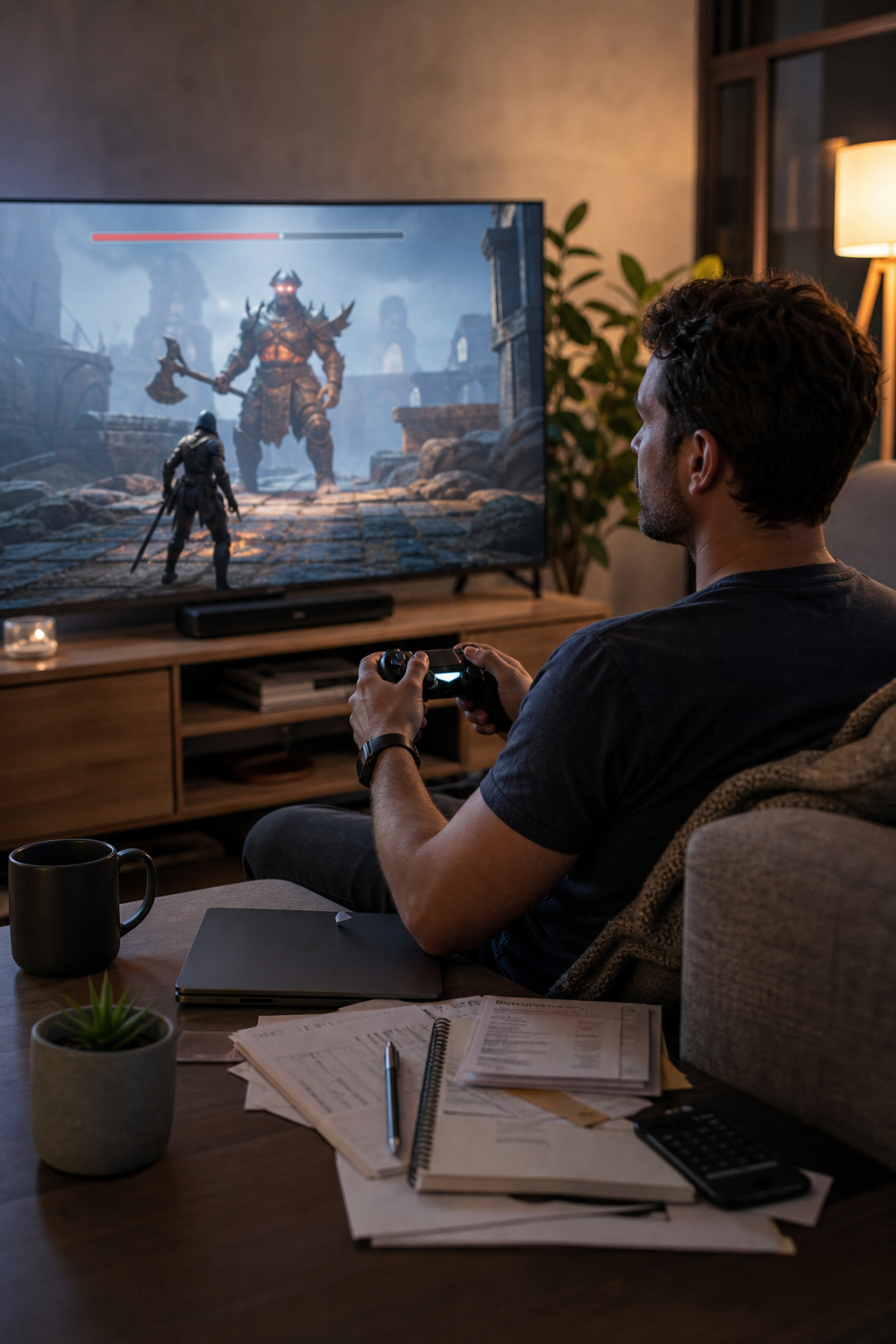
The Enemy Has a Health Bar
Wolverine gets knocked down.
He heals.
Then he goes back into the fight.
Most men do not heal that quickly.
There is no regeneration animation after a divorce.
No checkpoint before a layoff.
No flashing warning that your closest friendship has been quietly fading for three years.
No boss battle announcing that the next twelve months will be financially difficult.
Life rarely explains the mechanics before asking you to play.
That may be why the simplicity of a game can feel so satisfying.
For a few hours, the layoff can wait.
The dating apps can wait.
The court paperwork can wait.
The mortgage can wait.
The news can wait.
There is a controller in your hands and an enemy directly in front of you.
And unlike most of the things making you angry in real life, this one has a health bar.
If gaming is where the rules become clear again, the controller is where that sense of agency begins.
For PlayStation 5 players interested in Marvel’s Wolverine and the kind of focused, tactile experience discussed here, Sony’s DualSense controller is the hardware directly connecting the player to that world.
Browse Wolverine PS5 DualSense Controllers on eBayAffiliate link. GearCheckpoint may earn a commission from qualifying purchases.
Tomorrow morning, the harder game begins again
Marvel’s Wolverine will arrive on September 15, 2026, selling players a familiar superhero fantasy: become the dangerous person in the room and point that danger toward something that deserves it.
But the more interesting contrast may be outside the screen.
Millions of men live with pressures that cannot be confronted so directly. Their enemies arrive as numbers, emails, systems, bills, obligations and uncertainties.
No claws fix those things.
Neither does a PlayStation.
Gaming should not be romanticized into medicine, and a digital achievement should not become a substitute for every difficult part of real life.
But neither should recreation be dismissed simply because it occurs on a screen.
A good game can give someone a few hours of agency, challenge, friendship, laughter or uncomplicated fun in a life where very little feels uncomplicated.
Then the console turns off.
Tomorrow morning, the harder game begins again.
The one without a health bar.
The one without a reset button.
© GearCheckpoint
Leave a Reply