GTA VI’s Leonida Map: What Rockstar Has Actually Confirmed — and What Fans Are Still Guessing
A clear-eyed breakdown of Rockstar’s official reveals versus community reconstructions. We separate named, confirmed locales from the fan-made maps and the open questions that still matter before launch.
Table of Contents
› Quick Take› What Rockstar Has Actually Confirmed› Six Named Leonida Regions› Confirmed vs Community Reconstruction vs Unknown› What Fan Maps Can Tell Us› Where the Evidence Stops› What This Means for GTA VI’s Scale› What Rockstar Still Hasn’t Shown› Why the Distinction Matters› GearCheckpoint VerdictThe named regions are official. The complete map is not.
Rockstar has officially confirmed Leonida as the fictional state and six named areas inside it: Vice City, Leonida Keys, Grassrivers, Port Gellhorn, Ambrosia and Mount Kalaga National Park. Visuals and trailers show distinct environment types — tropical urban, islands/keys, wetlands, a port/industrial zone, more pastoral or exurban areas, and mountainous national parkland — but Rockstar has not released a complete, playable map, region borders, exact road layouts, distances between regions, or the locations of in-game activities and heists. Community reconstructions give plausible layouts and travel times based on footage, but they cross into speculation when they present exact city blocks, road geometry, and specific gameplay points as if official.
Rockstar’s trailers and marketing for GTA VI have given the community a lot to talk about — new characters, a recreated Vice City, and a handful of named regions inside a fictional state called Leonida. That has not, however, given us the finished map. The difference matters. Fans are hungry, and fan-made maps are clever; they are not the same thing as an official, ground-truthed geography from Rockstar. This article does one job: separate what Rockstar has actually confirmed from what the community has reconstructed and from what remains unknown. No guesswork will be passed off as firm fact. Where we infer or project, it will be labeled analysis.
What Rockstar Has Actually Confirmed
Be precise: Rockstar has published the following through official channels (trailers, statements, and promotional material):
- The name of the fictional state: Leonida.
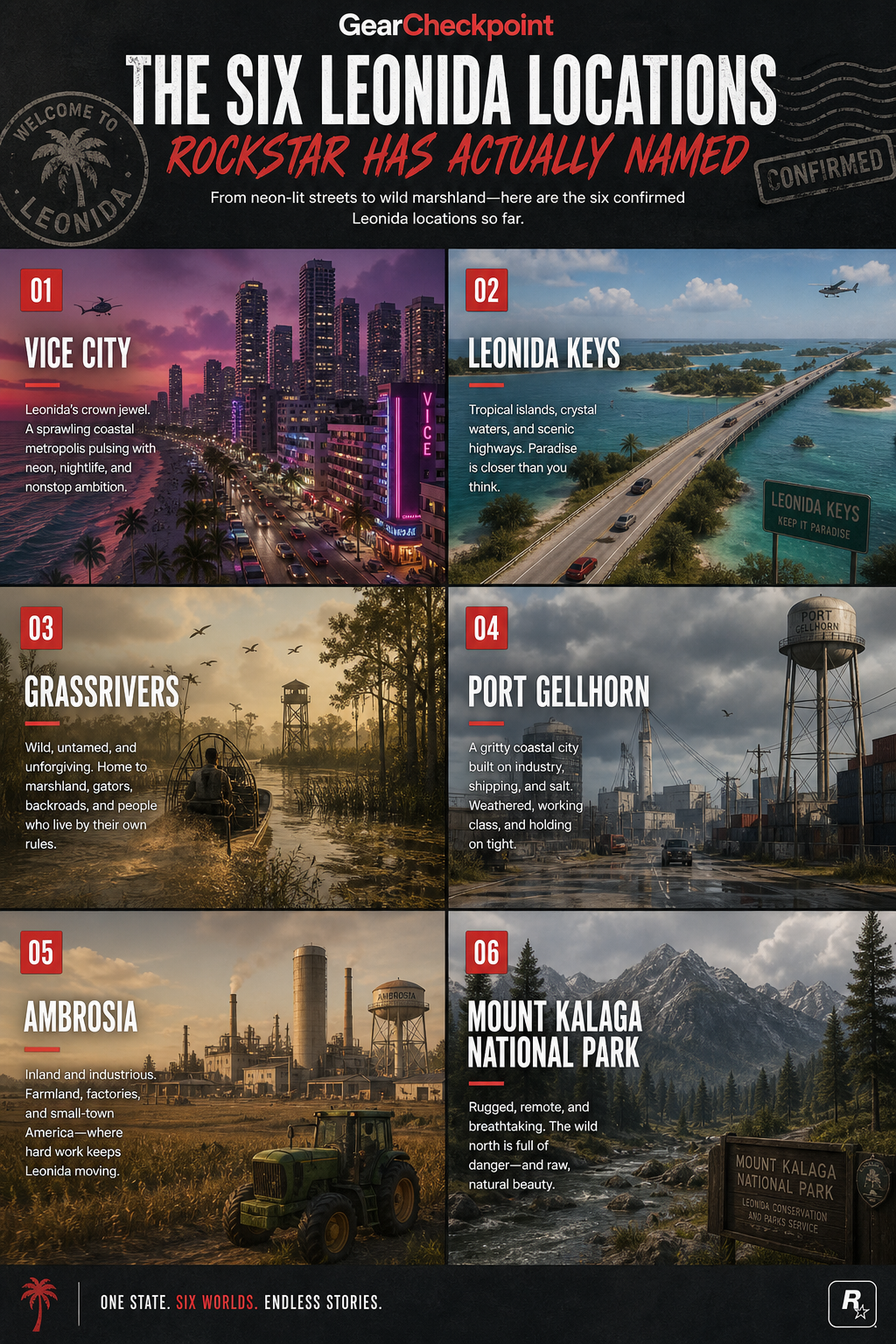
- Six named regions within Leonida: Vice City, Leonida Keys, Grassrivers, Port Gellhorn, Ambrosia, and Mount Kalaga National Park.
- Representative environment types via trailers and screenshots: an urban Vice City with a modernized, neon-inflected skyline; coastal islands that read as keys; wetlands or riverine lowlands; a port/industrial area; rural/exurban terrain; and mountainous parkland.
What Rockstar has not published (explicitly):
- A full, high-resolution static or interactive map showing playable boundaries.
- Exact region boundaries or administrative borders.
- Definitive road geometries, lane counts, or exact street grids.
- Distances or travel times between named regions as an official measure.
- Locations for in-game activities, heists, or GTA Online-specific points.
Six Named Leonida Regions
Below are the six Rockstar-confirmed regions with concise location cards (summary + what the official material shows).
- Vice City
- What Rockstar confirmed: The name and clear depiction in trailers and imagery. Vice City is presented as a major, dense urban center — Rockstar’s modern reimagining of the classic franchise city.
- What footage shows: high-rise districts, neon nightlife corridors, beachfront avenues, and avenues built for dense traffic and pedestrian life.
- Leonida Keys
- What Rockstar confirmed: The existence and name of the Keys region.
- What footage shows: low-lying islands, bridges, pockets of smaller settlements, and maritime features consistent with an archipelago.
- Grassrivers
- What Rockstar confirmed: The name Grassrivers.
- What footage shows: river systems, marshy floodplains, and agricultural or wetland-adjacent areas that contrast with urban Vice City.
- Port Gellhorn
- What Rockstar confirmed: The name Port Gellhorn.
- What footage shows: cranes, container yards, shipping infrastructure and a working port aesthetic — an industrial counterpoint to the tourist-facing beachfronts of Vice City.
- Ambrosia
- What Rockstar confirmed: The name Ambrosia.
- What footage shows: more pastoral or suburban environments, open terrain and perhaps small towns; it reads as the inland or exurban belt between Vice City and wilder country.
- Mount Kalaga National Park
- What Rockstar confirmed: The name Mount Kalaga National Park.
- What footage shows: steep slopes, forested mountain terrain and vistas implying a protected wilderness area with hiking roads and scenic overlooks.
Confirmed vs Community Reconstruction vs Unknown
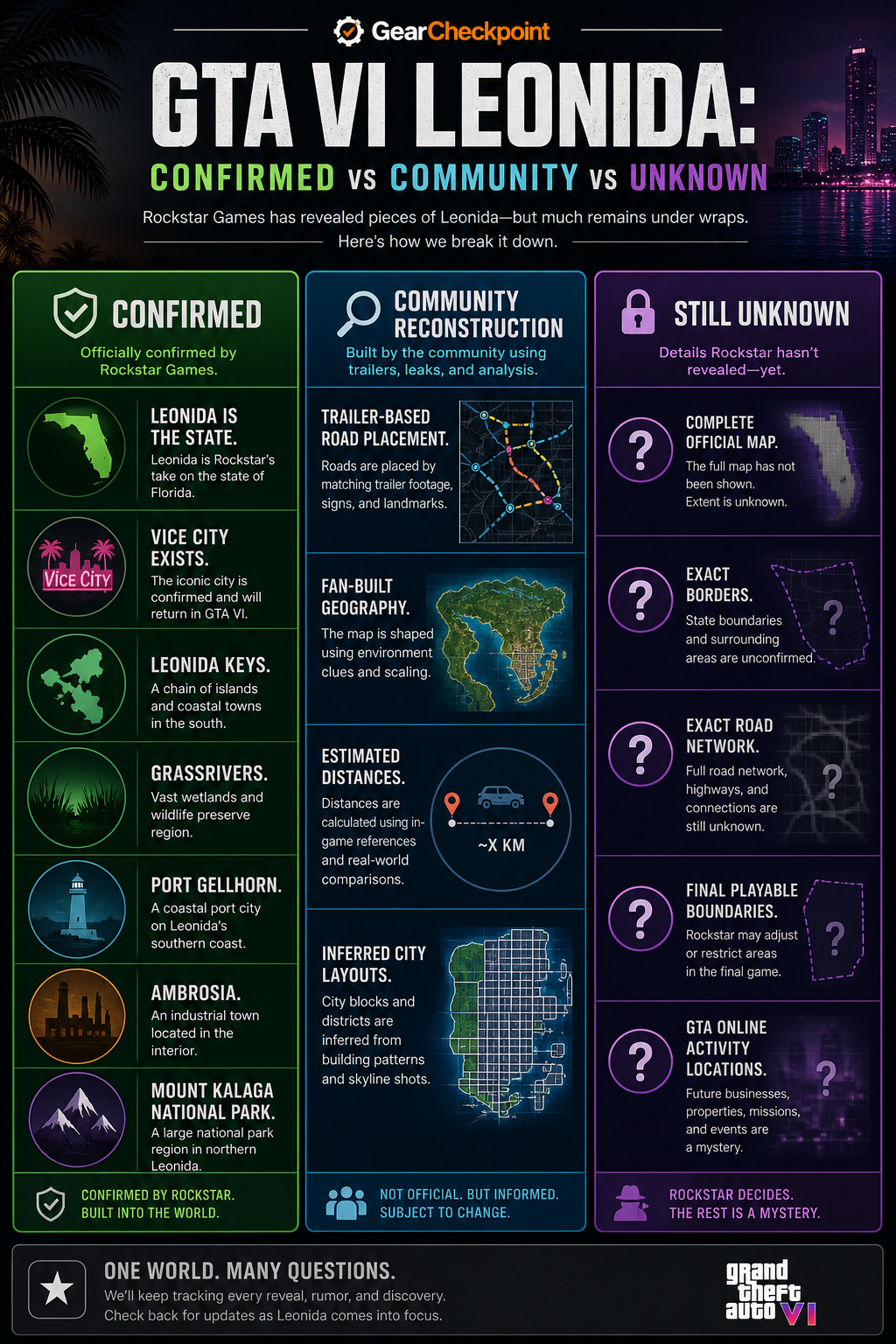
- Leonida (fictional state name)
- Vice City (named region)
- Leonida Keys (named region)
- Grassrivers (named region)
- Port Gellhorn (named region)
- Ambrosia (named region)
- Mount Kalaga National Park (named region)
- Representative environment types (urban, keys/islands, wetlands, port/industrial, rural/exurban, mountainous park) as shown in official trailers
- Fan-stitched maps based on trailer frames and timestamps
- Relative placement of landmarks and likely bridge/causeway locations
- Estimated travel times derived from observed vehicle speeds in footage (labeled as projections)
- Plausible city footprints or region adjacencies inferred from recurring skyline shots
- Annotated screenshots and layer-based reconstructions with stated assumptions
- Complete official playable map (high-resolution map with borders)
- Exact region boundaries and administrative borders
- Precise road geometry, lane counts, and full street grids
- Definitive distances between regions or Rockstar-provided travel metrics
- Exact locations of missions, heists, online activities, or PvP hotspots
- Final install size or system requirements tied to the completed world (until Rockstar publishes specs)
There are three categories readers need to keep separate:
- CONFIRMED: Rockstar-provided facts (names, high-level visuals of environment types, the state name).
- COMMUNITY RECONSTRUCTION: Maps and coordinates created by fans from trailers, footage timestamps, and in-game glimpses. Useful, but not official.
- STILL UNKNOWN: Anything that requires precise coordinates, road geometry, playable map edges, or activity locations.
A clear classification helps the community avoid treating detailed fan reconstructions as canonical. Fan maps are hypotheses, sometimes educated ones — and often very useful for expectations. But they are not Rockstar’s final word.
What Fan Maps Can Tell Us
Fan reconstructions are not worthless. When done carefully they provide several legitimate benefits:
- Environmental context: By stitching together trailer frames, fans can identify recurring landmarks, skyline silhouettes and likely relative positions. That reliably shows whether a location is urban, waterfront, island, port, wetland, or mountain.
- Travel-time estimates (as projections): Using vehicle speeds seen in footage and approximate on-screen distances, skilled data-sleuthers can produce travel-time estimates that are useful for expectations about scale. Treat these as projections, not facts.
- Plausible connectivity: Fan maps can indicate where bridges, causeways and main roads are likely to connect island clusters to the mainland. That helps anticipate chokepoints and natural traversal corridors.
- Comparative scale framing: By comparing known Rockstar city sizes (e.g., GTA V) to the visual density and skyline of Vice City footage, reconstruction teams can offer scaled estimates for players preparing hardware or forming gameplay expectations.
Where fan work becomes valuable, it is explicit about assumptions. The best reconstructions include notes: which frames were used, what assumptions about camera focal length were made, and where they interpolated missing data.
Where the Evidence Stops
There’s a hard line where useful reconstruction ends and speculation begins. Watch for these red flags in fan maps and clickbait headlines:
- Exact street grids presented without qualifiers. Trailers show a handful of shots; extrapolating a full street-by-street map assumes continuity not proven in the footage.
- Firm claims about distances between regions or official travel times. Unless Rockstar releases a map metric or in-game odometer evidence, distance claims are estimates.
- ‘Complete’ city interiors or building floor plans reconstructed from external shots. Cameras rarely show interiors exhaustively.
- Pinpointed locations of heists, PvP hotspots, or GTA Online activities presented as definitive. These are gameplay details Rockstar historically withholds until launch or specific feature reveals.
- Statements that fan maps equal the final playable borders. Rockstar has a track record of keeping exact playable limits internal until launch.
Be skeptical of any map that stops listing assumptions. If a map doesn’t show its method, treat its fine details as conjecture.
What This Means for GTA VI’s Scale
We can make careful, labeled inferences about scale without calling them confirmed:
- Diversity of biomes suggests Rockstar is aiming for a state-sized play area with vertical and horizontal variety — urban high-density zones, island networks, wetlands and inland rural or exurban areas, an industrial waterfront, and a mountain park.
- That environmental variety implies multiple traversal and gameplay systems (cars, boats, off-road vehicles, potentially aerial traversal). However, the presence of those systems has not been confirmed for every region; this is projection based on the environments shown.
- Scale estimates from fans that compare trailer footage to past Rockstar maps are useful guideposts. They indicate a potentially larger or at least more environmentally varied map than single-city designs, but the final playable footprint and loading/instancing behavior remain unconfirmed.
What Rockstar Still Hasn’t Shown
Before launch, key things Rockstar has not made public include:
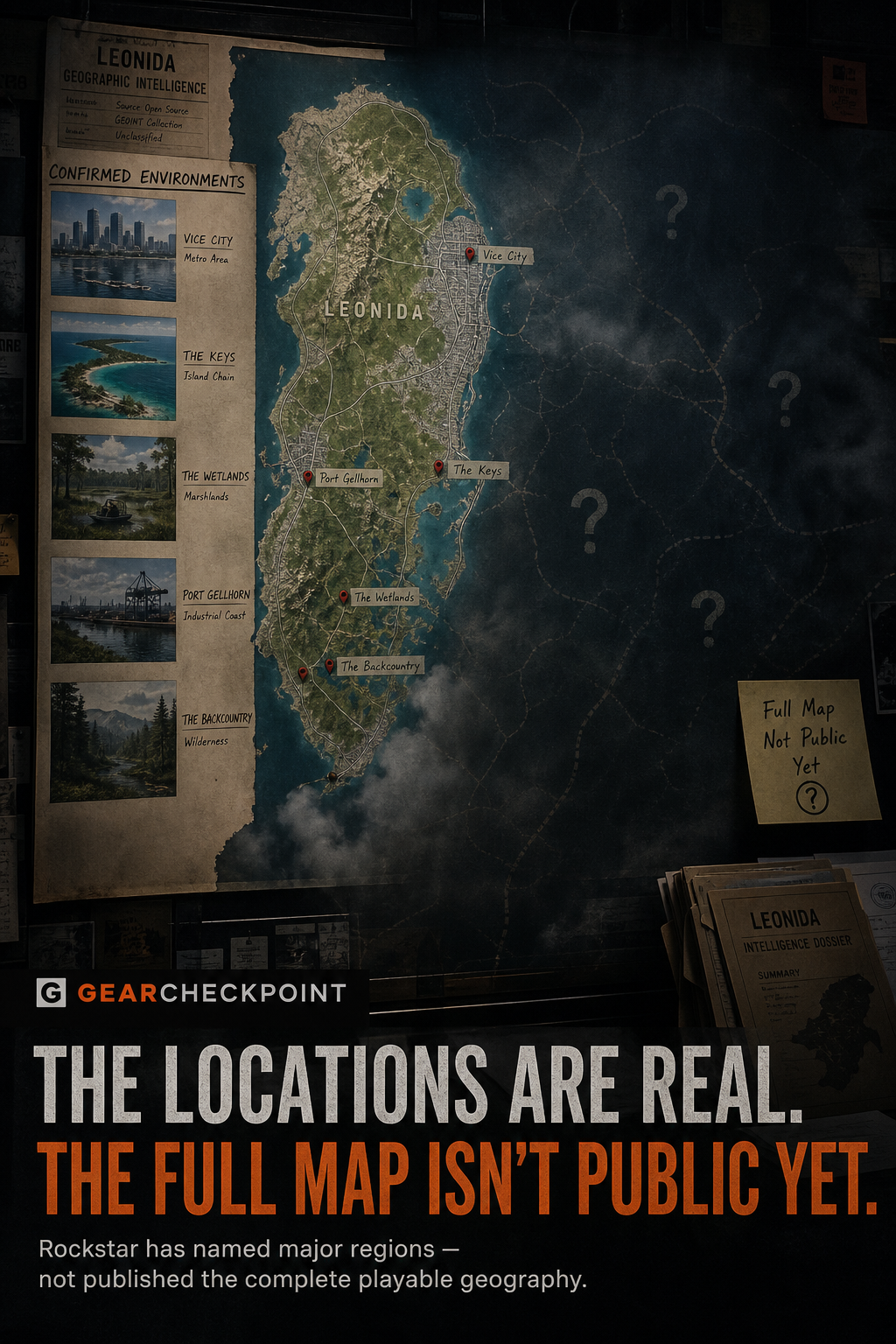
- A complete, official map showing playable borders and region boundaries.
- Exact road geometry, lane counts, and technically precise layouts for navigation systems.
- The specific locations of missions, heists, or multiplayer activities inside Leonida.
- Any official, guaranteed install size or technical requirements tied to the final game world. (Rockstar will publish system specs closer to release.)
Why the Distinction Matters
It matters for players, modders, content creators and journalists for three reasons:
- Expectations and hardware planning: Treat fan-scale estimates as provisional when making hardware or storage decisions. Don’t assume a specific install size unless Rockstar specifies it.
- Creative integrity: Reporting or resharing reconstructions as fact fuels confusion and false assumptions in the community.
- Developer levers: Rockstar has legitimate design reasons to withhold exact map geometry — streaming, instancing, mission gating, and GTA Online integration are all technical and design variables that affect the final playable map.
Affiliate note — storage recommendation Preparing for a large modern open-world library is sensible. If you’re upgrading storage ahead of next-gen releases, consider a high-capacity NVMe SSD or official console storage expansion to make room for multiple big titles. One practical option available on eBay is a high-capacity PS5-compatible NVMe SSD (search results): https://www.ebay.com/sch/i.html?_nkw=PS5+NVMe+SSD&campaignid=5339164287 (rel=”nofollow sponsored”). This is a preparatory move for large libraries, not a claim about GTA VI’s final install size.
Planning storage before the next huge open-world install
Rockstar has not announced GTA VI’s final install size. But if your current game library is already tight, additional compatible storage is one practical upgrade you can make without pretending we know the final requirement.
Check PS5 NVMe SSD options on eBayAffiliate link. GearCheckpoint may earn a commission from qualifying purchases.
What you can trust right now
Rockstar has given us firm anchors: Leonida and six named regions. Those anchors confirm a multi-biome design intent — city, keys, wetlands, port, pastoral territory, and mountain park. Beyond that, the map is intentionally incomplete in public view. Community reconstructions are often thoughtful and valuable for reading the trailers, but their fine-grained claims are reconstructions and projections, not official cartography. If you want to stay grounded:
- Treat named regions and environmental types as confirmed.
- Treat fan maps as educated hypotheses that require methods and caveats to be credible.
- Treat any claim of a full, exact playable map, precise roads, or specific activity locations as speculation until Rockstar publishes it.
What to watch for next
- Any official Rockstar map release or interactive map widget — that would change the conversation overnight.
- Technical deep dives from Rockstar about world streaming, boundaries, and multiplayer instancing — those are the practical details that determine how big the playable world feels.
- Trailer frames with more continuous coverage or long takes across multiple regions — they improve the quality of community reconstruction and reduce the space for wild speculation.
In short: appreciate the sleuthing, but keep the categories separate. Rockstar has confirmed Leonida and six named regions — everything else is either community reconstruction or an open question.
Leave a Reply